Today, July 4th, at 6:00 am, we had the first glimpse of Apple's fawn. In honor of Independence Day, we have named her "Flag".
Wednesday, July 4, 2012
Tuesday, June 26, 2012
Return of Black Rat Snake
I first posted a pic of the Black Rat Snake in June 2009. When we saw another one in June of 2010, we wondered if it could be the same one except this one was blind in one eye. Now, 2 years later, the snake with just one eye was on the flagstone in front of the shed again. He was rubbing his face against the stones trying to remove some of his dead skin around his head and neck. While I watched him perform this task, he was able to remove a large piece of dead skin from the top of his head...including a thick mass which was covering his blind eye. Since he has apparently made a home under the shed, we will have to give him a name. Please send me your suggestions!
Saturday, June 16, 2012
Skunk
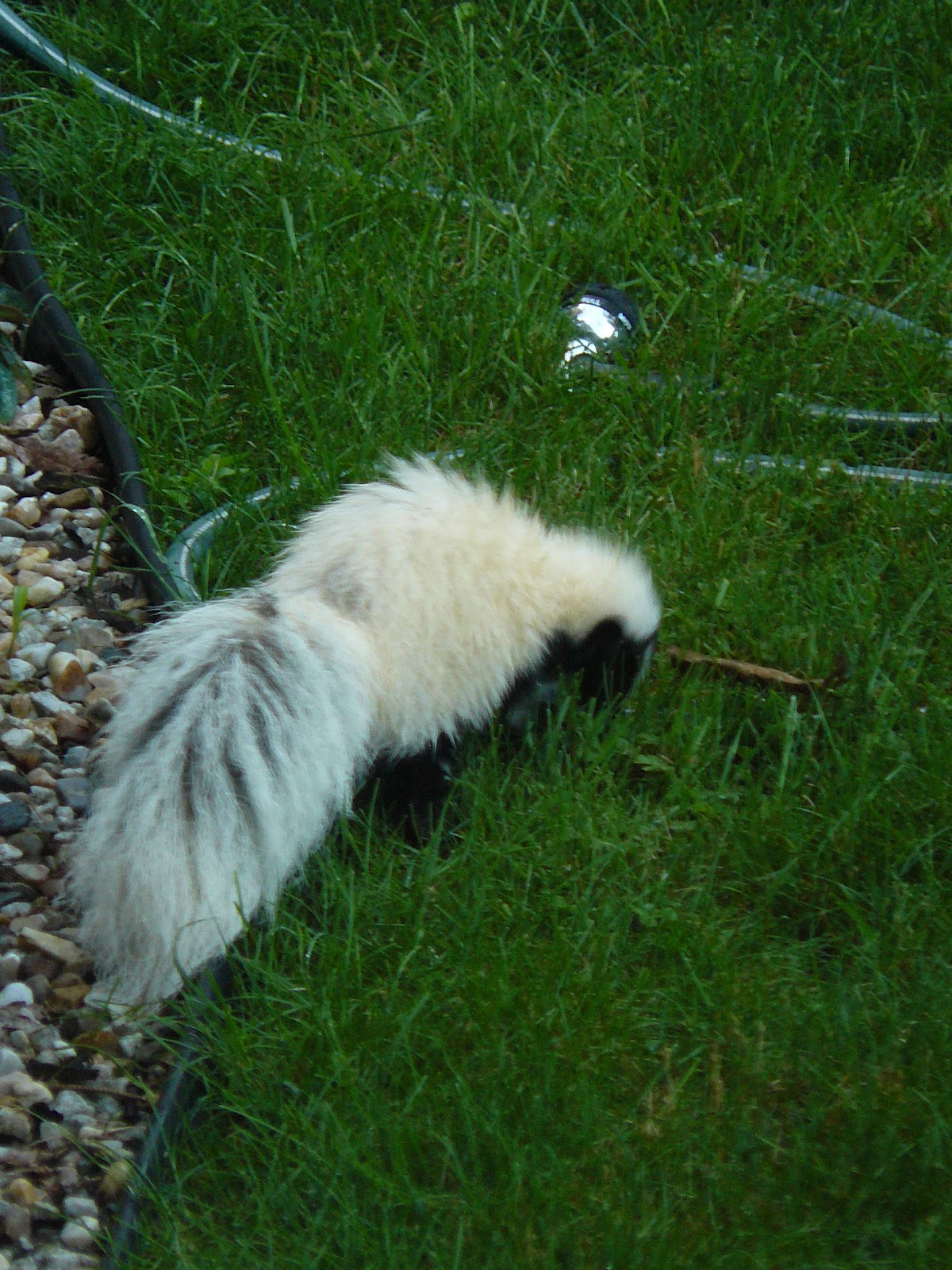
At this time of year we have several skunks come to yard looking of grubs and worms in the lawn. This one was a bit unusual in his coloring as he is almost all white.
Garter Snake
After a night of rain, I found this snake sitting on top of fern.
The habitat of the garter snake ranges from forests,
fields, and prairies to streams, wetlands, meadows, marshes, and ponds, and it
is often found near water. It is a semi-aquatic animal like most snakes.
It is found at altitudes from sea level to mountain locations. Their diet
consists mainly of amphibians and earthworms, but also fish, small birds, and rodents.
Garter snakes are effective at catching fast-moving creatures like fish and
tadpoles. Animals that eat the Common Garter Snake include large fish (such as bass and catfish), bullfrogs, snapping
turtles, larger snakes, hawks, raccoons, foxes, wild turkeys and domestic cats and dogs.
The
saliva of a garter snake may be toxic to amphibians and other small animals. For
humans, a bite is not dangerous, though it may cause slight itching, burning,
and/or swelling. Most garter snakes also secrete a foul-smelling fluid from
postanal glands when handled or
harmed.
Saturday, June 2, 2012
Monday, April 16, 2012
Look Whoo-Whoo came to visit today
About 8am today the Barred Owl flew in and landed at the edge of the woods. About 15 minutes later another one flew to an adjoining tree. It was wonderful to see both of them. We hear them calling at night and early morning.
The Barred Owl hunts by waiting on a high perch at night, or flying through the woods and swooping down on prey. A Barred Owl can sometimes be seen hunting before dark. This typically occurs during the nesting season or on dark and cloudy days. Daytime activity is often most prevalent when Barred Owls are raising chicks. However, this species still generally hunts near dawn or dusk.
The Barred Owl's nest is often in a tree cavity, often ones created by pileated woodpeckers it may also take over an old nesting site made previously by a red-shouldered hawk, cooper's hawk, crow, or squirrel. It is a permanent resident, but may wander after the nesting season. If a nest site has proved suitable in the past they will often reuse it as the birds are non-migratory. In the United States, eggs are laid from early-January in southern Florida to mid-April in northern Maine, and consist of 2 to 4 eggs per clutch. Eggs are brooded by the female with hatching taking place approximately 4 weeks later. Young owls fledge four to five weeks after hatching. These owls have few predators, but young, unwary owls may be taken by cats. The most significant predator of Barred Owls is the Great Horned Owl. The Barred Owl has been known to live up to 10 years in the wild and 23 years in captivity.
The Barred Owl hunts by waiting on a high perch at night, or flying through the woods and swooping down on prey. A Barred Owl can sometimes be seen hunting before dark. This typically occurs during the nesting season or on dark and cloudy days. Daytime activity is often most prevalent when Barred Owls are raising chicks. However, this species still generally hunts near dawn or dusk.
The Barred Owl's nest is often in a tree cavity, often ones created by pileated woodpeckers it may also take over an old nesting site made previously by a red-shouldered hawk, cooper's hawk, crow, or squirrel. It is a permanent resident, but may wander after the nesting season. If a nest site has proved suitable in the past they will often reuse it as the birds are non-migratory. In the United States, eggs are laid from early-January in southern Florida to mid-April in northern Maine, and consist of 2 to 4 eggs per clutch. Eggs are brooded by the female with hatching taking place approximately 4 weeks later. Young owls fledge four to five weeks after hatching. These owls have few predators, but young, unwary owls may be taken by cats. The most significant predator of Barred Owls is the Great Horned Owl. The Barred Owl has been known to live up to 10 years in the wild and 23 years in captivity.
Tuesday, March 13, 2012
Wood Frogs
Spring is definitely in the air for these two love frogs!! While clearing away leaves near the driveway, this pair appeared in the driveway. They were probably headed for the stream or small pond in the wetland area. My thanks to Bridget for seeing them hoping down the driveway.
The Wood frog is the state amphibian of New York.
Similar to other northern frogs that hibernate close to the surface in soil and/or leaf litter, wood frogs can tolerate the freezing of their blood and other tissues. Frogs can survive many freeze/thaw events during winter if not more than about 65% of the total body water freezes.
Wood frongs are one of the first amphibians to emerge for breeding right when the snow melts, along with Spring Peepers.
The Wood frog is the state amphibian of New York.
Similar to other northern frogs that hibernate close to the surface in soil and/or leaf litter, wood frogs can tolerate the freezing of their blood and other tissues. Frogs can survive many freeze/thaw events during winter if not more than about 65% of the total body water freezes.
Wood frongs are one of the first amphibians to emerge for breeding right when the snow melts, along with Spring Peepers.
Subscribe to:
Posts (Atom)